

Introduction
Learning routines play a central role in shaping students’ experience at TLS Academy. Rather than relying solely on sporadic discipline or abstract values instruction, the school uses consistent daily structures to guide students’ work, their management of responsibilities, and their academic progress within a supervised environment.
As a full-time private Christian school in Singapore, TLS Academy serves local and international students from Grade 1 to Grade 12. The school provides an American High School Diploma pathway and uses the Accelerated Christian Curriculum (ACE) within an individualised learning model. These routines give this model its daily rhythm by providing students with clarity, stability, and clear expectations around effort, behaviour, and progress.
For many families, especially those whose children have struggled in large or inconsistent systems, the absence of predictable structure can lead to disengagement, stress, or conflict around learning. When expectations shift frequently, students may find it difficult to develop a sense of responsibility or confidence in their ability to manage schoolwork independently.
By embedding these routines into daily academic life, TLS Academy reframes progress as the result of consistent habits rather than pressure or comparison. This supports the formation of values, accountability, and steady development within a transparent educational pathway that can feel reassuring for both students and parents.
Key Takeaways:
- How do daily structures influence the way students experience school?
Learning routines give students a steady framework for how each school day begins, continues, and ends. This helps them understand expectations, approach work with clarity, and remain engaged without relying on last-minute pressure.
- Why do routines matter for responsibility?
Daily routines make responsibility part of school behaviour. Students learn to manage tasks, complete work carefully, and recognise that progress is linked to consistent effort rather than occasional bursts of performance.
- How are values formed through everyday learning?
Daily routines help values such as discipline, perseverance, integrity, and accountability become visible in academic conduct. Character is shaped through repeated practice, not only through instruction.
- How do routines support academic progress?
Daily routines allow steady progress to be monitored. Students can advance at an appropriate pace, revisit difficult areas, and build confidence through mastery rather than comparison.
- Why does this approach reassure parents?
Daily routines give parents peace of mind because the school day is structured, supervised, and purposeful. Clear routines reduce uncertainty and support a more stable view of their child’s development.
The Role of Learning Routines in Daily School Structure
2.1 What Learning Routines Mean Within TLS Academy’s Model
At TLS Academy, learning routines refer to the predictable daily structures that guide how students begin their work, move through curriculum units, complete assigned tasks, and review progress under supervision. These routines form the backbone of the school day and shape how students engage with learning consistently rather than only when tests or deadlines approach.
These routines are not the same as lecture schedules, bell-driven timetables, or class-wide lesson plans. They guide the learning process rather than forcing every student to move at the same speed. This matters in an individualised school model, where students work through academic material at a pace suited to their readiness while still following a stable daily structure.
By replacing uncertainty with a consistent framework, daily routines reduce emotional friction around expectations. Students know what learning requires of them each day, which allows attention to shift from coping with change to engaging with understanding, effort, and completion.
This continuity matters across both primary and secondary levels. As students progress through different stages of schooling, the underlying structure remains familiar, allowing them to focus on growth rather than repeatedly adapting to new systems or instructional styles. For families considering private schools in Singapore, this consistency can provide reassurance that their child’s learning environment remains stable and supportive across different stages of growth.
The structure also supports students who may have felt overstimulated, overlooked, or discouraged in conventional settings. When the learning environment is predictable, students are better able to regulate attention, manage expectations, and respond to academic demands with greater stability.
2.2 Why Routine-Based Learning Supports Independent Responsibility
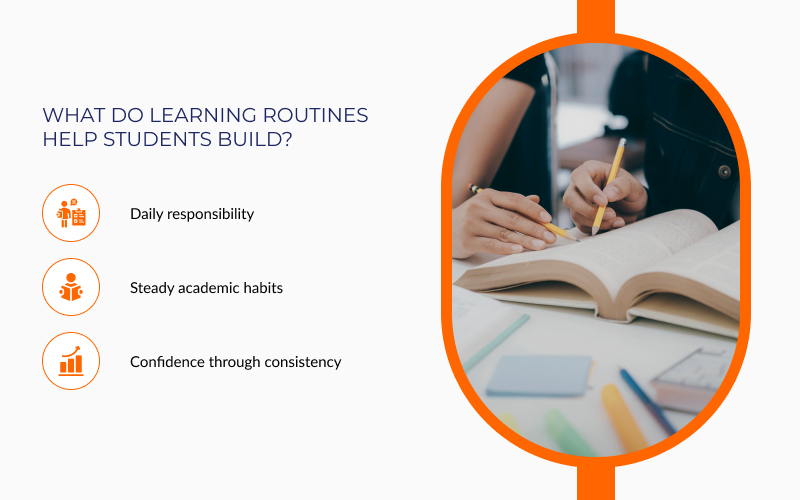
TLS Academy’s independent-learning approach requires students to take ownership of daily academic responsibilities within defined daily routines rather than relying on constant prompting or external pressure. Responsibility is not treated as a quality that students either have or lack. It is practised through repeated engagement with schoolwork, supervision, and completion.
Within this model, students learn that responsibility is exercised through planning, sustained effort, careful correction, and task completion. Progress reflects consistent habits rather than short-term performance. This helps students understand that their daily choices directly affect academic progress and personal growth.
By working within predictable structures, students gradually develop time awareness, self-management, and the ability to regulate their learning behaviour. These skills are not expected to appear immediately. They develop through repetition, guidance, and clear accountability.
Supervision plays a critical role in supporting independence. Educators can observe patterns in focus, effort, pacing, and completion over time. This means guidance can be given before difficulties grow into larger obstacles. Independence is therefore developed in a supported environment rather than through unstructured autonomy.
Responsibility at TLS Academy is not assumed at enrolment. Learning routines allow responsibility to develop progressively, helping students build confidence and self-direction at a sustainable pace while remaining clearly accountable for their learning. This continuous practice of self-management naturally prepares the student for character development and values formation.
How Learning Routines Reinforce Values Through Daily Practice
3.1 Values Developed Through Consistent Habits Rather Than Instruction Alone
At TLS Academy, values are reinforced through daily academic habits rather than only through standalone lessons or moral discussions. Students are encouraged to practise values within the real context of learning, where effort, honesty, patience, and follow-through are required each day.
Learning routines place values directly within academic behaviour. Completing work carefully, revising when errors appear, asking for help appropriately, and persisting through challenging tasks become daily opportunities to practise discipline, perseverance, and integrity. This guided experience is consistent with wider international conversations around social and emotional learning.
Over time, repeated engagement with daily routines allows values to move from conscious effort to habitual response. A student who initially needs frequent reminders may gradually become more willing to start work, correct mistakes, and stay with difficult tasks because these behaviours have become part of daily practice.
Many Christian schools in Singapore place importance on values-based education, but these values become more meaningful when students practise them through daily habits, responsible learning, and steady academic effort.
3.2 Discipline Shaped by Structure and Predictability
Learning routines establish clear expectations around when work begins, how effort is sustained, and what completion looks like within the school environment. This removes ambiguity around behaviour and performance, helping students understand that discipline is linked to consistent participation rather than sudden pressure.
Students learn that discipline is not driven only by urgency, punishment, or fear of failure. It is formed through steady participation in structures that support progress. Expectations remain consistent regardless of mood or motivation, which helps students practise discipline even when tasks feel demanding.
Predictability also reduces emotional resistance to learning. When students know what the day requires, they spend less energy anticipating change or negotiating expectations. This makes it easier to settle into work and continue with appropriate support.
Discipline at TLS Academy is developed gradually. These routines allow educators to reinforce expectations without resorting to shame, abrupt consequences, or constant comparisons with peers. Students are guided back to the day’s structure, which helps them build self-regulation at a pace they can sustain.
Over time, students may come to experience discipline as stability rather than restriction. The fairness and consistency of routine-based expectations help discipline become internalised rather than only externally imposed.
3.3 Integrity Reinforced Through Supervised Independent Learning
Students at TLS Academy complete academic work independently while remaining under close supervision. This balance is important because it allows students to exercise responsibility while still being accountable for effort, accuracy, and follow-through.
These routines allow educators to observe patterns of consistency over time. Rushed completion, avoidance, uneven engagement, or gaps in understanding are less likely to go unnoticed when daily work follows a visible structure.
Integrity is reinforced as students learn that consistent effort is expected throughout the learning process, not only when outcomes are visible. Responsibility is tied to daily practice rather than isolated achievements. Students come to understand that genuine progress depends on honest effort and real understanding.
This matters in an independent-learning environment. Without an appropriate structure, independence can become uneven or poorly supported. With supervision, students are encouraged to complete work faithfully, correct errors carefully, and recognise that shortcuts do not build lasting mastery.
This routine-based approach supports integrity by making an honest effort part of normal school life. It reflects TLS Academy’s Christian worldview, where character is shaped through everyday responsibility, consistency, and accountability rather than through instruction alone.
Learning Routines and Daily Academic Progress
4.1 How Routines Support Mastery-Based Progression
Learning routines at TLS Academy support mastery-based learning, where students advance after demonstrating understanding rather than moving forward only because of age, cohort pacing, or fixed schedules. This allows learning to be measured by readiness instead of comparison.
Routine monitoring allows academic progress to be observed day by day. Small areas of difficulty can be identified early through consistent engagement with learning tasks, reducing the risk of gaps being carried forward unnoticed. This is particularly useful for students who need more time to rebuild confidence or strengthen foundations.
Students are not pressured to keep up with their peers. This structure allows progress to unfold at an appropriate pace, helping students focus on understanding rather than comparison. For some students, this can foster renewed confidence, as they are given time to master material before advancing.
Mastery achieved through routine reinforces the connection between effort, understanding, and advancement. Students begin to see that progress is earned through consistent work and genuine comprehension rather than short-term performance or external pressure.
Over time, daily mastery compounds into visible academic progress. Small, steady gains accumulate across weeks and months, allowing students to experience advancement as a continuous process rather than a series of abrupt jumps or setbacks.
This approach can reduce fear around falling behind. Students gain reassurance knowing they will not be pushed forward before they are ready, which helps rebuild trust in learning after previous academic frustration. For parents considering a Christian international school in Singapore, clarity around pacing can be an important factor in choosing an environment that supports long-term development.
4.2 Building Momentum Through Consistent Daily Engagement
Learning routines emphasise steady daily work rather than sporadic bursts of effort. Students engage with learning as a regular responsibility, which helps reduce the stop-start patterns that can undermine progress over time.
Regular completion and reinforcement allow students to experience progress in manageable increments. As understanding builds through daily engagement, students can regain confidence in their ability to learn, complete tasks, and sustain effort.
Routine-based learning also helps prevent regression when challenges arise. Consistent engagement protects against disengagement after difficulty, allowing students to recover and continue moving forward without losing momentum.
Over time, momentum can replace frustration as students see that consistent routines lead to tangible progress. Achievement becomes more predictable, reducing emotional volatility around learning and helping students view academic development as something that can be built steadily.
This rhythm supports long-term academic stability rather than short-term performance spikes. By reinforcing consistency over intensity, TLS Academy helps students practise the kind of sustained responsibility and life skills needed for later stages of education. This is especially relevant within an accelerated education pathway, where students benefit from a clear structure that supports both individual pacing and accountable progress.
The Impact of Learning Routines on Students and Families
5.1 How Routines Support Student Confidence and Accountability
Learning routines are central to rebuilding student confidence. Many students arrive after experiencing uncertainty, inconsistency, or repeated academic frustration. Clear daily structures replace this uncertainty with clarity, allowing confidence to rebuild gradually through small, achievable successes rather than sudden pressure to perform. Students know how work should begin, how progress is monitored, and what it means to complete tasks responsibly, which helps them spend less time second-guessing expectations and more time engaging with learning.
Responsibility strengthens when students see a direct relationship between daily effort and academic progress. Routines make this connection visible, helping students understand that advancement is earned through consistency rather than comparison or external validation.
Over time, accountability can shift from being enforced to being internalised. As routines remove ambiguity, students may begin anticipating responsibilities, managing time more independently, and taking ownership of their learning without constant reminders.
This supports a healthier relationship with schoolwork. Confidence grows from repeated experiences of mastery and completion, allowing students to approach learning as something they can manage rather than something to avoid.
5.2 Why Learning Routines Provide Reassurance for Parents
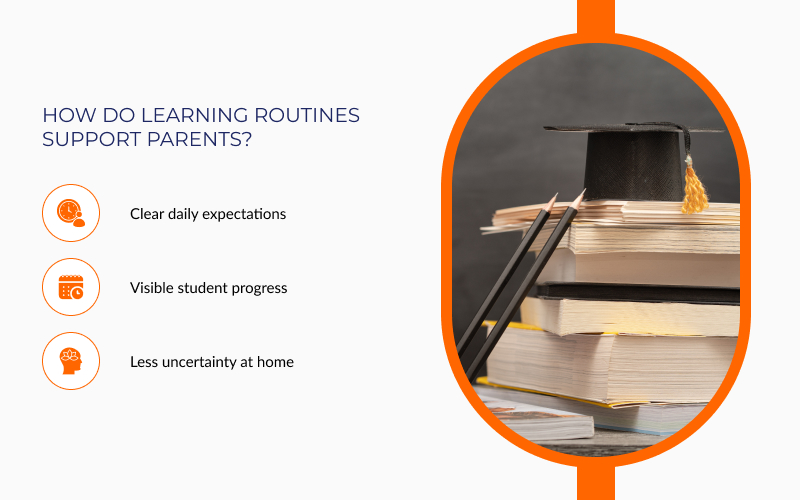
Learning routines give parents confidence that education is structured, supervised, and purposeful each day. Rather than wondering whether learning is happening, families can trust that the school day is guided by consistent expectations and monitored engagement.
Progress becomes visible through daily participation and steady advancement rather than being inferred only from occasional results. This transparency helps parents understand how their child is developing academically and personally over time.
For families who have previously felt the need to intervene constantly, this can bring emotional relief. When responsibility for learning is reinforced in the school setting, daily conflicts around homework, reminders, or monitoring may decrease. Parents are not left to carry the full weight of academic enforcement at home.
These routines also reassure parents because they create continuity. The same expectations are reinforced week after week, giving families a clearer sense of direction and stability. This is particularly valuable for local and international families seeking a school pathway that balances structure with individual attention.
A small limitation is worth recognising. Routines alone do not remove every challenge a student may face. Some students still need counselling, mentoring, patience, and close guidance, especially when academic or social difficulties have affected their confidence. TLS Academy’s broader holistic support helps ensure that structure is paired with care rather than applied mechanically.
Frequently Asked Questions
What are Learning Routines in a Full-Time School Setting?
In a full-time school setting like TLS Academy, Learning routines refer to the consistent daily structures that guide how students begin work, manage tasks, progress through curriculum units, and receive supervision. These routines are not fixed lecture timetables. They provide a stable framework that supports individual pacing, clear expectations, and accountability throughout the school day.
How Do Routines Help Students Who Previously Struggled in School?
Routines are particularly supportive for students who have experienced stress, disengagement, or inconsistency in previous school environments. Predictable structures reduce uncertainty by giving students a clear sense of what to do next. At TLS Academy, students are not rushed to keep pace with peers, and they are not left to manage learning alone. Supervised routines help rebuild confidence gradually through consistent effort and mastery.
Why Do Routines Give Parents Greater Peace of Mind?
Routines give parents reassurance because learning is structured, supervised, and monitored daily rather than dependent on infrequent results or last-minute intervention. Parents can see progress through steady engagement instead of waiting only for exams or reports. As responsibility is reinforced within the school environment, families often experience less conflict around daily reminders and monitoring.
Conclusion
Learning routines at TLS Academy are more than daily structures. They help students build values, take on responsibility, and achieve steady academic progress through predictable expectations, supervised independence, and mastery-based learning. With consistent guidance, students can rebuild confidence, take ownership of their work, and develop habits that support growth across subjects and school years.
For families, this provides clarity and reassurance. Parents can trust that learning is structured, progress is monitored, and students are supported with care rather than pressure.
Speak with TLS Academy to learn how we can support your child’s academic and personal development through structured routines, supervised independence, and values-based guidance.